
AI Cost Optimization
for LLM Inference & Agents
Reduce LLM token costs through semantic caching, inference optimization, and intelligent routing — across Claude, Cursor, and any AI agent.
Start free. No credit card required.
The Real Cost of Unoptimized AI Infrastructure
Token costs, session limits, and wasted context compound as AI adoption scales.
Skyrocketing Token Costs
Every word your AI processes costs money. Complex queries and lengthy interactions add up fast. Claude's token-based pricing ensures that every interaction directly contributes to your LLM bill.
Session & Usage Limits
Your AI cuts off or tells you to wait. Cursor usage limits and Claude session caps interrupt your flow just when momentum builds.
Wasted Context & Repetition
While careful prompt engineering can mitigate some issues, unoptimized context still leads to repetitive information, wasting expensive tokens and development time. Managing this complexity efficiently is key to cost control.
DataGrout's AI Cost Optimization Solution
Save tokens. Extend sessions. Keep costs predictable.
AI Agent
Cursor, Claude Code, etc.
(via API)
DataGrout MCP Server
Reduces tokens for data-heavy tasks
LLM API
Claude API, OpenAI, Gemini, etc.
How it works: DataGrout is an MCP server your agent calls explicitly — it never sits between you and your LLM provider. The agent decides when to call DataGrout tools (e.g., to filter 10k records) vs. when to call the LLM directly.
Token savings apply to all LLM interactions routed through DataGrout — including API integrations and compatible client applications (e.g., Claude Desktop connected via MCP). Direct consumer sessions that bypass DataGrout are not affected.
Semantic Caching & Memory
Your AI remembers what it learned. DataGrout stores frequently accessed information, so your agent gets instant answers without re-processing through the expensive LLM. Fewer LLM calls = significantly lower token usage. Leveraging saved virtual skills, repetitive planning and common queries never incur redundant LLM costs — your agent reuses cached reasoning indefinitely after paying the planning cost just once.
Inference Optimization (Governor)
Only use your premium AI when truly necessary. DataGrout intercepts routine requests with efficient symbolic responses, escalating to your LLM only for complex tasks — a core inference optimization strategy that saves up to 100x on common interactions.
Optimized Context
Empower your AI to craft perfect prompts. Your agent explicitly calls DataGrout's context optimization tools to intelligently distill and streamline conversation context. Features like refract trim raw data payloads before they reach the LLM, while compress and brief parameters strip schema overhead — ensuring the LLM receives only the most relevant information and significantly fewer tokens are consumed per interaction.
Pre-Calculate Costs Before You Commit
Before executing complex pipelines, use estimate_only to preview the exact token and credit cost of any operation — without actually running it. This prevents accidental expensive calls and lets you optimize your approach before committing. Combine with limit and min_score parameters on discovery calls to retrieve only high-confidence results and avoid processing unnecessary data.
Try the LLM Cost Calculator →Your agent just fetched 10,000 records.
Now what?
Three approaches to handling large API payloads in agent workflows. One costs 1,000× more than the other. The formula is visible.
APPROACH 1
Raw Context
Stuff the entire API response into the agent's context window.
// Agent receives the full payload
{
  "results": [
    {"Id": "00Q000000001",
     "Company": "Acme Corp", ...},
    {"Id": "00Q000000002",
     "Company": "Globex Inc", ...},
    ... 9,998 more records ...
    // -7.5 MB of JSON + ~1.9M
    // tokens
  ]
}APPROACH 2
Roll Your Own
Agent writes filter code across multiple turns. Or build custom hooks/scripts.
// Turn 1: Agent inspects a sample
// Turn 2: Writes Python filter
leads = [l for l in data
  if l["State"] ==
  "California"
  and parse(l["CreatedDate"])
  > cutoff]
leads.sort(key=lambda x:
  x["LeadScore"], reverse=True)
result = leads[:5]
// Turn 3: Verify and format output
APPROACH 3
DataGrout
Deterministic tools extract exactly what the agent needs. Zero LLM credits.
// Single MCP tool call chain
{
  "name": "data-
grout@1/frame.filter@1",
  "arguments": {
    "cache_ref": "rc_leads_abc123",
    "where": {"State": "California"}
  }
}
// + frame.sort + frame.slice +
// frame.select
// Result: 5 records, 6 fields =
// ~340 tokensfewer tokens with DataGrout vs. raw context
10k Salesforce leads · Claude Opus · 1 turn · fully accurate
Start saving tokens →Empirical Benchmark Results
Measured on generated datasets using DataGrout's deterministic tool suite.
Model: Claude Opus 4 at $15/1M input tokens.
Experiment 1: Salesforce 10k Leads
| APPROACH | INPUT TOKENS | COST | TURNS | ACCURATE | SAVINGS |
|---|---|---|---|---|---|
| Raw Context | 1,881,176 | $28.23 | 1 | No | baseline |
| Roll Your Own | 3,320 | $0.1548 | 3 | Yes | 99.8% |
| DataGrout | 343 | $0.0264 | 1 | Yes | 99.98% |
Experiment 2: Order Trend Analysis (5k orders)
| APPROACH | INPUT TOKENS | COST | TURNS | ACCURATE | SAVINGS |
|---|---|---|---|---|---|
| Raw Context | 519,180 | $7.81 | 1 | No | baseline |
| Roll Your Own | 4,300 | $0.2170 | 3 | Yes | 99.2% |
| DataGrout | 402 | $0.0585 | 1 | Yes | 99.9% |
Experiment 3: Multi-Source Integration (SAP + Salesforce)
| APPROACH | INPUT TOKENS | COST | TURNS | ACCURATE | SAVINGS |
|---|---|---|---|---|---|
| Raw Context | 350,150 | $5.30 | 1 | No | baseline |
| Roll Your Own | 6,150 | $0.3248 | 4 | Yes | 98.2% |
| DataGrout | 750 | $0.0738 | 1 | Yes | 99.8% |
Numbers measured on synthetic datasets representative of real enterprise workloads.
Case Study
95% Token Reduction via Selective Context Hydration
See how DataGrout's own Platform Advisor cut context tokens from ~3,240 to ~148 per query — without sacrificing answer quality.
See exactly where your AI money goes
in real time
Lumen is a free, open-source LLM cost monitor by DataGrout. It intercepts your LLM API traffic and surfaces cost, token rate, and cache savings as live arc gauges — think Activity Monitor for your AI spending. Native status bar app on macOS; browser dashboard on Linux and Windows.
macOS
Native app
Linux
Browser dashboard
Windows
Browser dashboard
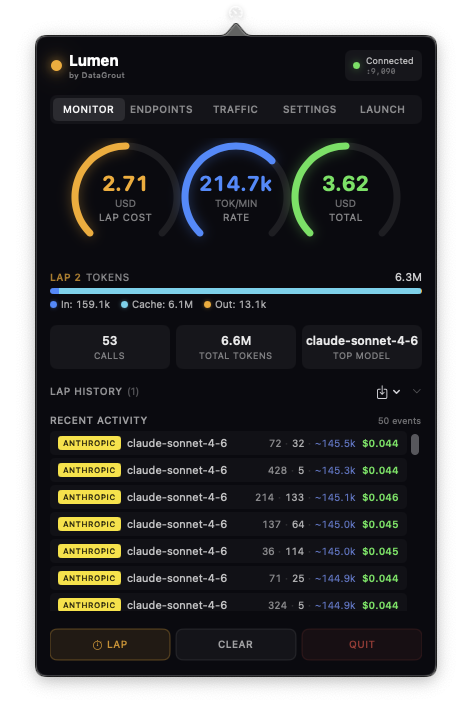
- Live gauges — cost, token rate, and cache savings as real-time arc meters
- Per-call cost breakdown with model attribution
- Cache hit visualization (vs. full LLM spend)
- Multi-provider: OpenAI, Anthropic, Cursor, and Google AI
- Lap tracking — mark sessions for before/after comparisons
macOS 14+ (native) · Linux & Windows (browser dashboard) · Rust-based proxy · Privacy-first — content never stored
How Lumen fits into the DataGrout cost optimization stack
Observe
Lumen
See live token rates and costs per call as they happen.
Optimize
Governor + Memory
Route and cache to reduce spend automatically.
Govern
Warden + Invariant
Enforce budgets, policies, and quality gates.
See the Savings in Action
DataGrout is already saving teams real money.
Total LLM Tokens Saved
Total Money Saved
Average Tokens Saved Per User/Month
Average Money Saved Per User/Month
Equivalent Session Extension (Claude Users)
Based on token savings and typical Claude conversation patterns
Numbers are for illustrative purposes; actual savings vary based on usage patterns.
Frequently Asked Questions
Answers to common questions about AI cost optimization and DataGrout.
Have a question we didn't cover? Contact our team.
Ready to Start Cutting AI Costs?
Route smarter, cache more, and see exactly where every token goes — free to start.
Building custom agents? Learn about the Conduit SDK.